Monday, March 26, 2018

Action


      Miriam Katin includes scenes with a high amount of action in her memoir. Since Miriam was only a child during the events that occurred in the memoir it is interesting as to which action scenes were emphasized. Miriam was very fond of her dog Rexy, which Esther had to hand over to the Germans, and was later befriended by the winemaker's dog. During some action scenes Miriam includes the dog's perspective on what is occurring such as when bombing was taking place or when he was shot by the Nazi soldier. This suggests that the action scenes in the memoir are described in the manner and intensity that Miriam perceived them to be. Along with the use of large, bolded and capitalized action words, the visuals in the action scenes were modified to enhance the severity of the situation as perceived by the reader. This is an effective technique as it encourages the reader to differentiate the action scenes versus the non-action scenes throughout the story.


(Katin, 2006)


(Katin, 2006)


https://kathytemean.wordpress.com/2010/11/23/12-tips-for-writing-action-scenes/
This link discussed techniques and tips on writing/drawing action scenes for a graphic memoir


Images


       Miriam Katin's memoir utilizes strong visuals to provoke certain emotions in the reader. The explicit visuals displayed during the scene where the Nazi soldiers invade the winemakers home and rape the women that were seeking refuge is disturbing and provokes a feeling of uneasiness. Miriam also changes the style of the visuals according to the emotions present in the scene. During a scene in which fear and pain is present the images are darker, lines are less defined and certain images are blown out of proportion.


(Katin, 2006)

      Miriam Katin also utilizes different themes to make the reader comprehend the story better. Color images are used to display present day scenes. The contrast between the black and white images versus the color images conveys a message that the scenes of the past were dark times in her life and the color scenes represent a more favorable period in her life. Miriam also uses expressions to make the reader aware of the emotional state the character is in and provides context to the dialogue which only printed text would be unable to achieve.

(Katin, 2006)


https://bookriot.com/2014/10/01/my-kryptonite-the-thing-about-graphic-memoirs/
This link describes different techniques some athours have used when writing their graphic memoirs and how they enhance the reader's experience.


Structure

The memoir is structured in graphic novel format, switching from World War II era to the 1960-70s. The eras are defined by the use of colour in the more recent times and black and white further in the past. This is due to the influence of black and white photography that is a characteristic of this era. The graphic novel guides the author to feel closer to the author, seeing what she sees in her mind in regards to the memory. It also adds substance to a memory that might be short in Miriam's mind, but the images add weight, and a more accurate description - this is especially applicable when some memories can be heavily based on sight, and to share to the viewer the emotions of the characters when there is not a narrator involved. 

An unusual point in the structure is that the protagonist of the memoir, Esther, is not a character inspired my the memoirist but rather her own mother. Miriam, the child who doesn’t quite understand the war happening around her, is the author of the memoir and much more central to the side plot than she is to the main plot.


https://www.theparisreview.org/blog/2013/04/18/an-enormous-amount-of-pictures-in-the-studio-with-miriam-katin/
This is a blog looking at Katin's workspace in her home - she talks about how she developed her graphic novels and her inspiration! I recommend checking it out to get a feel of how she went about throwing together We Are On Our Own!


Themes

Themes that can be found are struggle, perseverance, fear, togetherness, overcoming, love and war. As with any tragedy, a multitude of themes can be found throughout. We see these themes throughout the use of image, dialogue, behaviour of characters and the content of the memoir itself. 
Related imageImage result for we are on our own miriam katin
Struggle, perseverance and fear are a constant theme displayed throughout the memoir. We see this with the use of low and wide angled shots, they create an appearance of loneliness and insignificance - the close shots allow the viewers to feel sympathetic and emotional for the characters. This is also portrayed to the viewer through the mothers thoughts. The author constantly shares her mothers thought with the viewer, they are often fearful and worrisome. The persistent running of the mother and daughter help portray these themes of hardship. We see that war is also continuously mentioned throughout the novel, through conversation of the characters, images of nazi flags, and appearances of soldiers. 

The more positive themes of overcoming and love are displayed less often throughout the novel. The coloured pages help enforce the more positive themes. Coming from black and white images - times of hardship - the colour represents a new beginning, easier times and togetherness. This is also seen through the faithfulness of the mother to her husband until they find each other again. Finally, it is also significant that this entire journey is completed by a daughter and mother side by side - togetherness and love are portrayed heavily as we see the sacrifices one is made for the other, and the bond the share which is more evident to the readers near the end of the book when they are on the phone speaking about the time in the snowfall. 

Crisis has a tendency to toss us from one extremity to the next, and calls out aspects of ourselves that we may not normally practice or express. Powerful emotions are being portrayed throughout.

https://ehne.fr/en/article/wars-and-traces-war/representations-war/comics-and-war
This link talks about comics and memoirs created in Europe during the first world war and whether they are an instrument of propaganda, heroisation or denunciation.


Sunday, March 25, 2018

Media with Miriam Katin

Miriam Katin's Interview Regarding "Letting It Go"

Above is a short interview with Miriam Katin and her feelings towards her driven novel "Letting It Go".


Miriam Katin's Speech for Jewish Education Regrading WWII

Above is a skit of Miriam Katin engaging about the life of her book "We Are On Our Own." She uses this book as a platform for talking about Communism, Totalitarianism, and the fall of innocent Jewish citizens regarding the WWII

Author's Works

Listed below is collection of Miriam Katin's list of work:

- A Certain Hunger 1965
- A Short Geography of Undocumented Kisses
- Rosenkavalier 67 (2010)
- Rosetta (2002)
- Eucalyptus Nights (2006)
- Curried Away (2007)
- In Plain Sight (2007)
- Live Broadcast (2009)
- The Way We Must Live (2007)
- Petite Cousine Et Grane Historie (2008)
- Bronka, Donkey, Tzila, Dolek, Shabbetay, Katz and McNamara (2003)
- Theomimesis (2003)
- The Ring of Meryem (2003)
- The Seven Sweet Spoonfuls of Understanding (2001)
- Parfait (2001)
- Oh to Celebrate (2001)
- Mittei Europa Rerun (2000)


Her Awards are as follows:
- Association of Journalists and Reviews of Comics
- Grand Prix de la Critique 2008
- Inkpot Award, Comic-con Inter San Diego 2007
- Nominated for Will Eisner Comic Industry Award: Best Short Story 2002


Miriam Katin really focuses on past experiences with her work. It is a way for her to naturally express her feelings. What drives her comics is her passion to make people laugh but also though the way of educating about the past. Her work is often transferred from English to other languages such as French and Polish.

Personal Relation to We Are On Our Own


Personally I don’t think I can relate to this graphic memoir as it was written in a dark time in which both mother and daughter were trying to escape. But I think that it can relate to the diary of Anne Frank, both books are written in a Childs perspective although Anne was in hiding she was also Jewish and she lived in the time of the war. While I read the Diary of Anne Frank I also felt scared for her and sorry for what Anne and her family had went through where as I had the same feelings while reading Miriams graphic memoir as well. I think that it was book a very dark and scared time for both of the girls and maybe while being a female myself although I have never gone through a dark time such as this, sometimes you have to grow up faster and be more mature than you should be as a child. It makes me think that I have a great life and I should be thankful for the family and the life that I live seeing as others don’t have the little things that maybe I take for granted and that we should appreciate the little things in our lives as well because sometimes those around us don’t have the smalls things that we have. Life can be made up of many words and images and each and every one of our lives and the people around us is different.
Related image

Social Aspects

The social aspects of this graphic memoir are very different, rather than other books or journals that were written in the time of World War II this graphic novel was different. Although it was written by Miriam Katin as an adult while reading this book you feel the Mariam as a child because she was so little at the time of the war Miriam wrote it as if she were still a child. The pictures help us to visualize what was going on through Miriam’s brain and what visual ties stuck with her based upon her memories.  Having both pictures and comic bubbles to help up understand what was going on lead us to understand and have a different aspect of what was happening in the War.  The art in the graphic novel We Are On Our Own is just amazing and gives us a different aspect through the drawings as the ones drawn in black and white are drawings about the war and those in colour are Non war scenes to show a more upbeat time. 


Wednesday, March 21, 2018

Mirian Katin- We are our own. Characterization

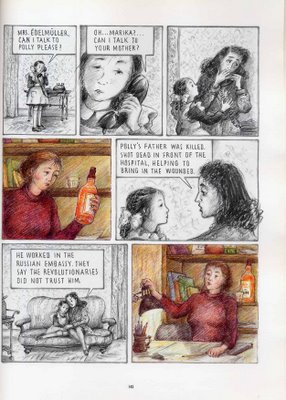
Esther, who is Miriam's mother, underwent a significant change in character as the story progressed. In this particular scene it is evident that Esther realizes that she must alter her character if she is to survive the challenges that await her. Esther and Miriam were forced to endure many hardships on their journey to find safety from the war. Esther went to extraordinary lengths to ensure the safety of Miriam and herself, it is during these scenes that we are able to truly appreciate the resilient character of Esther.

(Katin, 2006)


Throughout  the memoir, we are provided with snippets of Miriam's life as an adult. These scenes are shown in color to resemble present day. Miriam's pessimistic character is revealed to the reader in these scenes. Also, Esther's religious beliefs are suggested to be non-existent in these specific scenes. As the story unfolds the reader learns that David, Esther's father, has lost his faith in God due to his experiences during the war. Miriam's traumatic experiences coupled with the influence of her father may have been the source of Miriam's character as an adult. 


(Katin, 2006)                                                                                                            (Katin, 2006)


Tuesday, March 20, 2018

Purpose

Like mentioned in previous blog entires: there is a huge historical influence on the story line of Katin's memoir. We can clearly see the hardship that Esther and her daughter went through while traveling across Nazi invaded territory. Its a story of oppression, discrimination, and loneliness. Katin uses this memory of her childhood to create a purpose of awareness, catharsis, inspiration and historical reference.

This memoir is nothing short of an emotional and sentimental story. Like many old war stories, too often personal insight gets lost and the memories fade due to the passing of time. The stories of your grandma or grandpa from the times of the war will only exist as long as they do, or in your memory of them. I think that one purpose of this memoir was partially to fulfill Katin's sense of responsibility to share her mothers story of escaping the Nazi's. Which I think is a common thought amongst individuals who have inspirational war stories - Katin being an aspiring writer, this gave her purpose and subject in which to begin her career. Therefore I think this graphic memoir aids in the preservation of these significant experiences and provide insight into the actual conditions and emotions lived through.

Related image

This might have also been therapeutic experience for Katin - a potential way for her to let out any long lasting emotions or dwelling thoughts from this exhausting memoir. Writing helps to heal in soul in someways, and it allows a new kind of processing to take place in the brain. When you integrate the memories into your regular memory, you can move into a present and future renewed and with more energy–the pain of the past is put into perspective–perhaps not forgotten, but no longer seeming like an immediate and current injury. In some ways, this might also be quite therapeutic for the reading, whether they are able to relate to the story or not, they are able to travel through time into a personal journey through another's memoir.

Here is a link that elaborates on that final thought - memoirs are written for a path of healing and self awareness!
http://memoriesandmemoirs.com/memoir-writing-a-creative-path-to-self-awareness/

Cultural Aspects


Before World War II, approximately 200,000 Jewish people lived in Budapest, making it the center of Hungarian Jewish cultural life. In the late 1930s and early 1940s, Budapest was a safe haven for Jewish refugees. Before the war approximately 5,000 refugees, primarily from Germany and Austria, arrived in Budapest. While many thought that Budapest was a safe place as the war began they then realized as the Germans started to occupy more of the land the less safe and secure that felt. In March 1944 he Germans ordered the establishment of a Jewish council in Budapest and severely restricted Jewish life. Jewish people such as Miriam and her mother would then be rounded up and snatched of their homes and lives that they once lived. They were forced to scatter for safety or they would be put into refugee camps. This meant that Jewish people were no long allowed to live freely; they would no longer be able to celebrate their culture that they once had no fear to show. Between April and July 1944, the Germans and Hungarians deported Jews from the Hungarian provinces.  The Hungarian authorities had put many Jews into homes that were scattered throughout the city and marked with the star of David, they were being victimized for their culture and their relgion which is seen within the graphic novel.
Image result for we are on our own  miriam katin page 9


this video https://www.youtube.com/watch?v=8j-Vte6meqA    shows a visual aspect of how the culture and the environment had been ruined and taken by the Germans in the time of 1944

Historical aspects

Based upon reading the graphic novel "We Are on Our Own" Miriam Katin portrays the events that occurred in WWII. Miriam emphasizes on her perception of war and tragedy which can be greatly understood from a younger age groups point of view. The tragedies of the world wars are contextualized through her illustrations and writing within this novel.  We are On Our Own visualizes Miriam’s life after war and the changes she goes through in her daily life. The book starts of with Esther Levy, who is Miriam’s mother who takes care of two-year-old Miriam alone in Nazi-occupied Budapest while her husband fights in the Hungarian army In 1944 there were Over 184,000 Jewish people in Budapest.. This graphic novel can be seen as part of history and the war. This novel shows what Miriams family has gone through while her father was at war and her mother was striving to keep both herself and Miriam away from the Nazi Hunters. Esther stays out of the way of being found by living on a farm.  When Trouble comes around when the local Nazi Commandant spies her. Suspecting she is a Jew, instead of turning her in, he forces her to become his mistress. Soon this horror gives way to another as the Nazis retreat from the advancing Russian troops. The Russian's vodka-fueled barbarism sends Esther fleeing into a snowstorm, pulling Miriam behind her. This shows that many victims had to live in hiding for years before the war was over. Because the perspective is that of a very young child, the readers are spared some of the horrifying details that can often be found in Holocaust stories.

Based upon Miriam growing up in budapest i thought that this video would give us more insight and a visual view of what was going on in Budapest at the time of the war in 1944.

http://www.criticalpast.com/video/65675032365_peace-meeting_marchers_banners_posters_torch

Monday, March 19, 2018

Miriam Katin - Influences

A majority of Miriam Katin's work is based off of her life experiences of growing up as Jew. Whether it be from her escape as a child from Hungry, or her trials and tribulations with Israel, Miriam finds that through her drawings is the best way for her to express her emotions. With Jewish News 1, Miriam reflects about her emotions about her son accepting citizenship into Berlin, Germany. When her son first told her where he was planning to move, Miriam was not able to adequately talk about how she felt. Letting it Go, is a story of her drawing out the accounts of that life event. She holds nothing back as she even includes the part where when visiting her son, she soiled herself while sleeping on the first night. To find the news clip, click the link below:
https://www.youtube.com/watch?v=6OcJ4auLjAI


It was not until she was 62, that Miriam decided to dictate a graphic novel about her own WWII survival story. Seeing Art Spiegelman's novel, Maus, said that it gave her "permission" to write about her own accounts. Feeling that her mother would be reluctant of her chosen career path, she was hesitate at first about exposing her true life events. In her memoir: We Are On Our Own, she was able to involve her mother in the pre-printing process in which her mother gave her the confidence to publish the book. All of her work is about her struggle about being a Jewish citizen. She writes about her lack of faith, troubled relationships, family hardships and her direct place in history.

Interview with the Jewish Women Archive:

https://jwa.org/blog/graphic-details-interview-miriam-katin

Miriam Katin (Early/Late Life)

Miriam Katin – About the author

Early Life: Miriam was born in Hungary in 1942 where she lived with her mother and father. Being brought up in the Jewish religion during World War II (WWII) brought challenging times to her family. Miriam and her mother created a conspiracy in which they faked their own deaths to leave the country. Later, she immigrated to Israel in 1956 where she was accepted into the Israel Defense Forces and apprenticed as a graphic artist in Tei Aviv studios. In Ein Gedi Animation studio, she was employed as a background designer for Jumbo Pictures, Disney Studios, Nickelodeon, and MTV Animation in New York from 1999-2001. 

Later Life:

Around the year 2000, Miriam started creating her own comics. She currently lives with her husband Geoff  in Washington Heights, NY. She has a son and a daughter. To date she has published 18 comics, and 2 books including: We Are On Our Own (2006), and most recently: Letting it Go (2013). There is rumors of an upcoming book to be released about her father’s experience during the WWII.

More can be found on Miriam from her website: http://www.miriamkatin.com


Plot

Plot


Miriam Katin's We Are On Our Own is a story of life and death during the Nazi occupation of Hungry. Its a journey of a mother's courage in the face of a very real nightmare. In the memoir, Latin recalls her mother, Esther Levy, who takes care of two-yer-old Miriam in Nazi-infested Budapest while Miriam's father is away fighting in the war. Andrew Arnold also argues that the plot "explores the precarious nature of religious faith, which for some can be stretched too thin for suspension." This may become more evident to the reader when looking at particular symbols used in the text, and the seemingly worsening series of events.

The tale begins with Esther and her best friend sharing coffee in na urbane and middle class environment. They're discussing how the death traps of the Nazi's are setting in, demanding they hand in their dog - which then was followed by commanding all the jews leave their possessions nd report to the ghetto. Fearful about the rumours of round-ups in which no one returns - Esther purchases fake identity papers as a servant girl with n illegitimate daughter. She burns all of her personal identifies, including her photographs and family bible, before fleeing the city. Miriam calls out that her mother has burnt God, but Esther replies that He is with them, and will protect them on their journey.
Image result for we are on our own miriam katin dog gets shot scene


Once out of the city, Esther finds a couple willing to take her in and protect her and her daughter. Trouble finds its way in when a local Nazi Kommandant becomes curious and suspects that she is a runaway Jew. But instead of turning her in, he forces her to become his mistress. This situation soon escalates when advancing Russian troops appear at the door. This sends Esther and her draughting fleeing into a snowstorm.
Image result for we are on our own miriam katin

Andrew Arnold states that this is the boss thematic climax. Some may see that the coming down of snow and shelter is protection from the hand of God, but then we see the dog shot by the soldiers and Miriam comes to a different conclusion (Arnold. A, 2006). Again, she finds a place to stay but is forced to give up her wedding ring as payment, another religious symbol for faithfulness and obedience.


Between these black and white scenes of horror, we see flashes of Miriam's life, in full colour, decides later. Her and her husband struggle with the decision to immerse him in Hebrew school "with our own kind", as her husband says, and she replies "You mean separate. Again." These flashes into the future show the lasting, idling effects on Mariam, although, we find out later, she hardly remembers any of it. Living a secular, nonreligious life seems to be her reaction to the brutality she and her mother experienced.
Image result for we are on our own miriam katin

Spring of 1945.
Miriam finds comfort with an old acquaintance, David, at a refugees aid centre in Borosvar. Life becomes more enjoyable again for Esther and her daughter - they begin to laugh and share quality time together. David begins to think that Esther is his new start at a wife and family. It isn't long before Esther senses these feelings, but remains devoted to her unfound husband.

Finally, near the end of the book, we see Miriam's father. Having survived the war, he returns to Budapest in search of his family, only to find them long gone! Here we see a parallel journey as Miriam's father traces their footsteps to Esther's previous accommodations, until finally he runs into David, who points him towards his final destination.

Upon being reunited with each other, Esther is hugely relieved, but all Miriam can speak about is her dog: "and Rexy did not come back". She doesn't recognize her father, instead goes to play with the toys, a stuffed dog and a toy soldier. Recalling the incident in the snowstorm, she hides the stuffed dog and violently attack the toy soldier. The last thing she says is "and what if mommy burned that god after all?", potentially implying that their relationship with God is now non-existent.


Heres a little more on Andrew's Article; he relates this memoir to many other completed by Katin.
http://content.time.com/time/arts/article/0,8599,1199859,00.html


Sunday, March 18, 2018

Outstanding Scenes- We are on our own


I believe there are many outstanding scenes in the graphic memoir "We are on our own" by Miriam Katin. One of the early scenes in the graphic memoir gives us a glimpse of the potential hardships the character experienced. This scene describes the Nazi's to be synonymous with "darkness". This was an effective way for the reader to understand the authors perspective on the Nazi's. I feel that this scene is powerful and prepares the reader to discover some of the terrible acts committed by the Nazi's.

Katin, 2006


The scene where the Nazi soldiers barged into the wine makers home, where Esther and Miriam were staying along with other women, who's husbands' were taken away or killed, were staying as well. The scene displays the brutality of the Nazi soldiers and their lack of remorse. This is a shocking scene that bluntly displays some of the horrors that Esther experienced on her journey.

Katin, 2006

The scene in which David proclaims that he has lost faith and no longer believes in God is very powerful in my opinion. One can only imagine what David has experienced and witnessed to drive him to the point where he no longer believes in God. The fact that Miriam is present and aware, when Davis says this, indicates that this may play a role into Miriam's own beliefs.


Katin, 2006 

One of the final scenes in the memoir is the most outstanding, in my opinion. Throughout the memoir Miriam seemed to not be significantly affected by what was going on and in some cases seemed oblivious. However, this scene makes it very clear that what had occurred to her mother and her had greatly affected her. This scene shows Miriam re-enacting acts of violence on her toys and shows an act of vengeance on one toy that resembles a Nazi soldier. This shows the reader that Miriam was very aware of what had happened and displays what seems like "hate" growing in her.


Katin, 2006